Amanda Jane Graham
A Tribute To The Irish Community Butte Montana 1916-1919
A Tribute to the Irish Community, Butte, Montana 1916–1919 is a biographical and autobiographical body of work rooted in family memory and oral history. The project grew out of Amanda Jane Graham's grandmother's childhood memories of growing up in the Irish-American community of Butte, Montana, in the early twentieth century.
Graham uses drawing, etching, embroidery, sculpture, and found images to tell stories about migration, political activism, community, and childhood. She looks at how personal histories are remembered, shared, and changed over time.
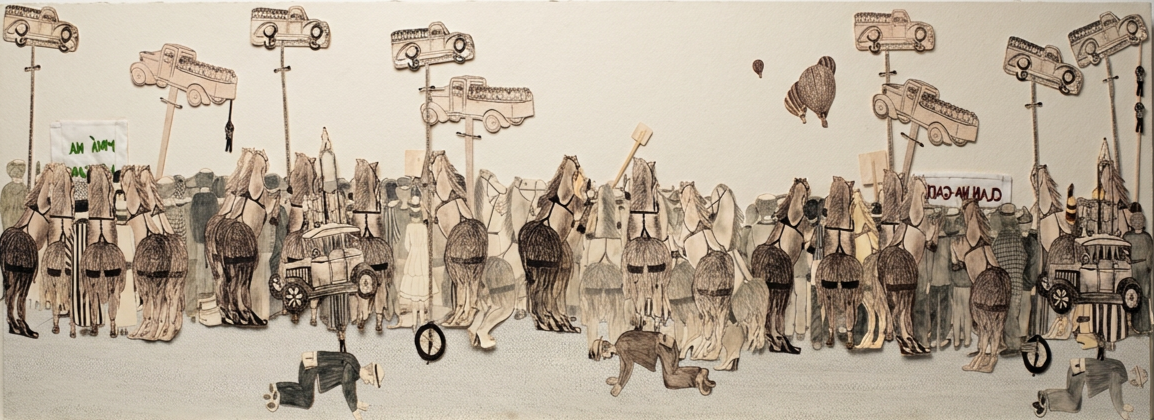
De Valera's Rally Montana 1919
Graphite, ink, hard- and soft-ground etching, embroidery and on wood,
240 × 70 cm, 2009

De Valera's Rally Montana 1919, 2009. Detail
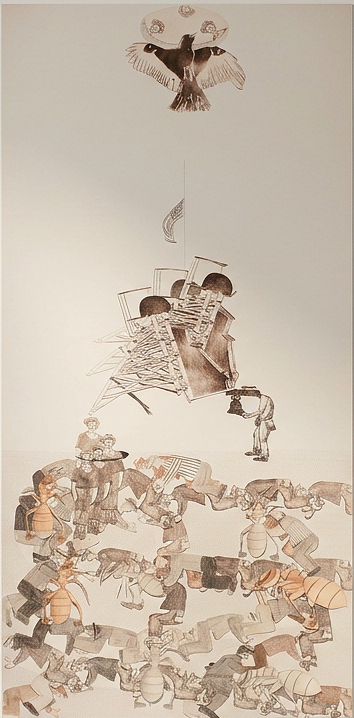
Butte Mining Disaster 1917
Graphite, ink, hard- and soft-ground etching on wood,
210 × 90 cm, 2009
A Story Carried Through Generations
The stories Graham heard from her grandmother became an important source of both imagery and methodology. Her grandmother recalled growing up in Butte, Montana, within a large Irish-American community whose political and cultural connections extended back to Ireland.
Among the stories was one about her grandmother, at age three, unknowingly carrying money concealed in her doll's pram to Ireland in support of the 1916 Easter Rising.
Repeatedly telling and retelling these memories became central to Graham's understanding of oral history: stories change through memory, yet remain powerful carriers of personal and collective experience.

The S.S. Tuscania
Hard-ground etching and aquatint
70 × 35 cm, 2009

Exhibition Documentation
RHA Gallery
A Tribute to the Irish Community, Butte, Montana 1916–1919
Dublin 2017
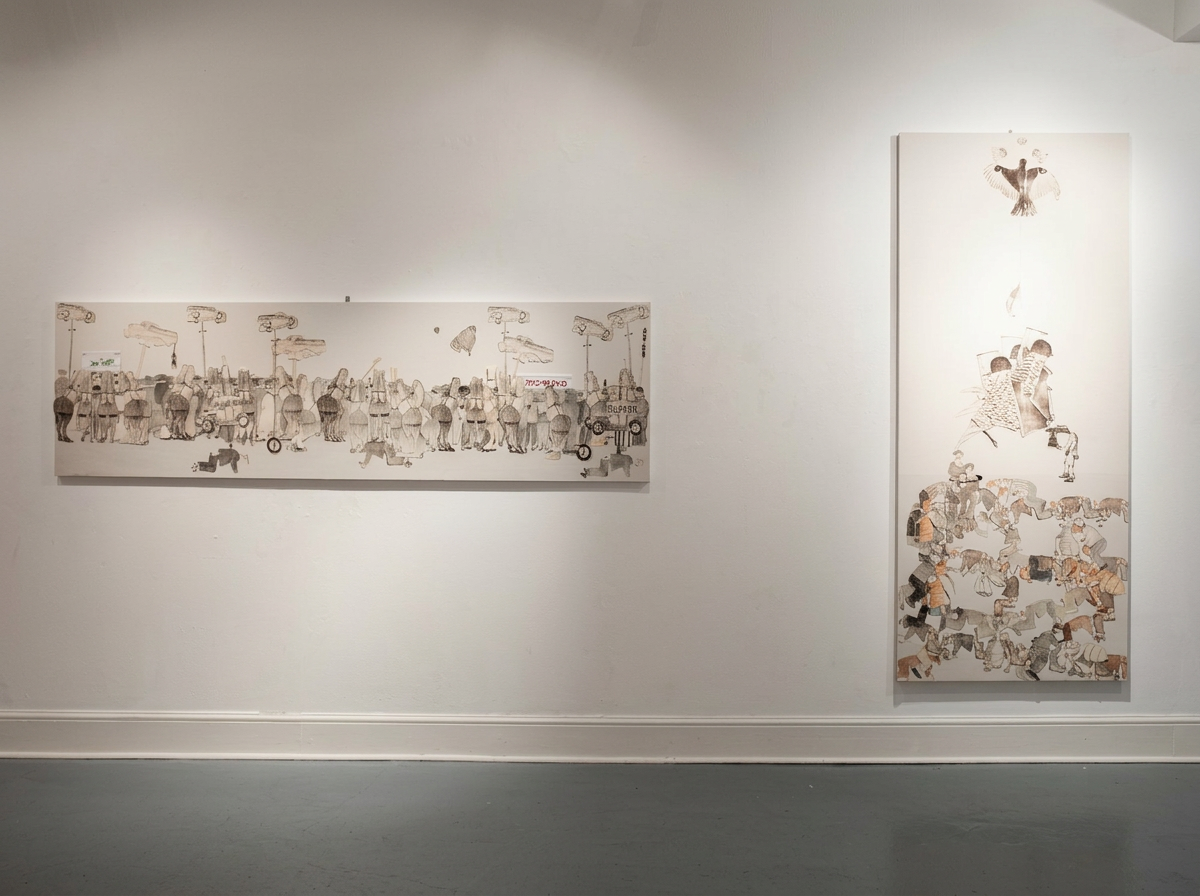
Cross Gallery
Repetition
De Valera's Rally Montana 1919
240 x 70 cm, 2009
Butte Mining Disaster, 1917
210 x 90 cm, 2009
Dublin 2017

About The Project
A Tribute To The Irish Community Butte Montana 1916-1919 is both biographical and autobiographical. It revolves around memory, narrative, and family history told to Graham by her grandmother of her childhood memories.
Graham combines personal history with her sense of humour to create quirky and humorous characters and scenes. As a child, she was intrigued by the stories about her grandmother's childhood in Butte, Montana, at the start of the twentieth century and how it was to be an Irish American whose family was very involved in the Fenian movement.
At the age of three, her grandmother unknowingly smuggled money into Ireland. It was hidden in her doll's pram to aid the 1916 Easter Rising. Her ever-growing curiosity and voracious appetite for narrative demanded the constant retelling of these stories.
Even with time, these memories are embellished and gilded in her mind, and she can retrieve them with the most exquisite detail. Graham can visualise her grandmother as a child enjoying cowboy shootouts or enduring car overcrowding as the community travelled vast distances to listen to Eamonn DeValera at the rallies.
She can still sense her grandmother's apprehension when she recalls the stories of the mine bell ringing as her grandmother witnessed the worst mining disaster in United States history. This reminiscence has instilled in Graham's mind the importance of oral history and the storytelling tradition from one generation to another.
Ormston House
Essays for the House of Memory, Ormston House
The Richest HillOn Earth
Steel and Dolls Pram
210x100cm, 2013